
Salesforce provides the “Where is this used?” button, but in a complex Org with years of technical debt, that linear list often isn’t enough. You need to see the web of connections to understand the impact truly.
Enter dependency_viewer—a CLI and web-based tool designed to visualize your Salesforce metadata dependencies, analyze code health, and help you make changes with confidence.
The Problem with Complexity
As Salesforce Orgs mature, metadata relationships become a spaghetti intersection of Apex, Triggers, Custom Objects, and Pages. Standard dependency APIs are powerful, but they are often slow to query in real-time and return raw data that is hard to mentally model.
The Solution: Local Data, Visual Graph
The dependency_viewer solves this by taking a hybrid approach:
- Extract: It uses the Salesforce Tooling API via the
sfCLI to fetch dependency data. - Store: It saves this data into a local SQLite database for instant access.
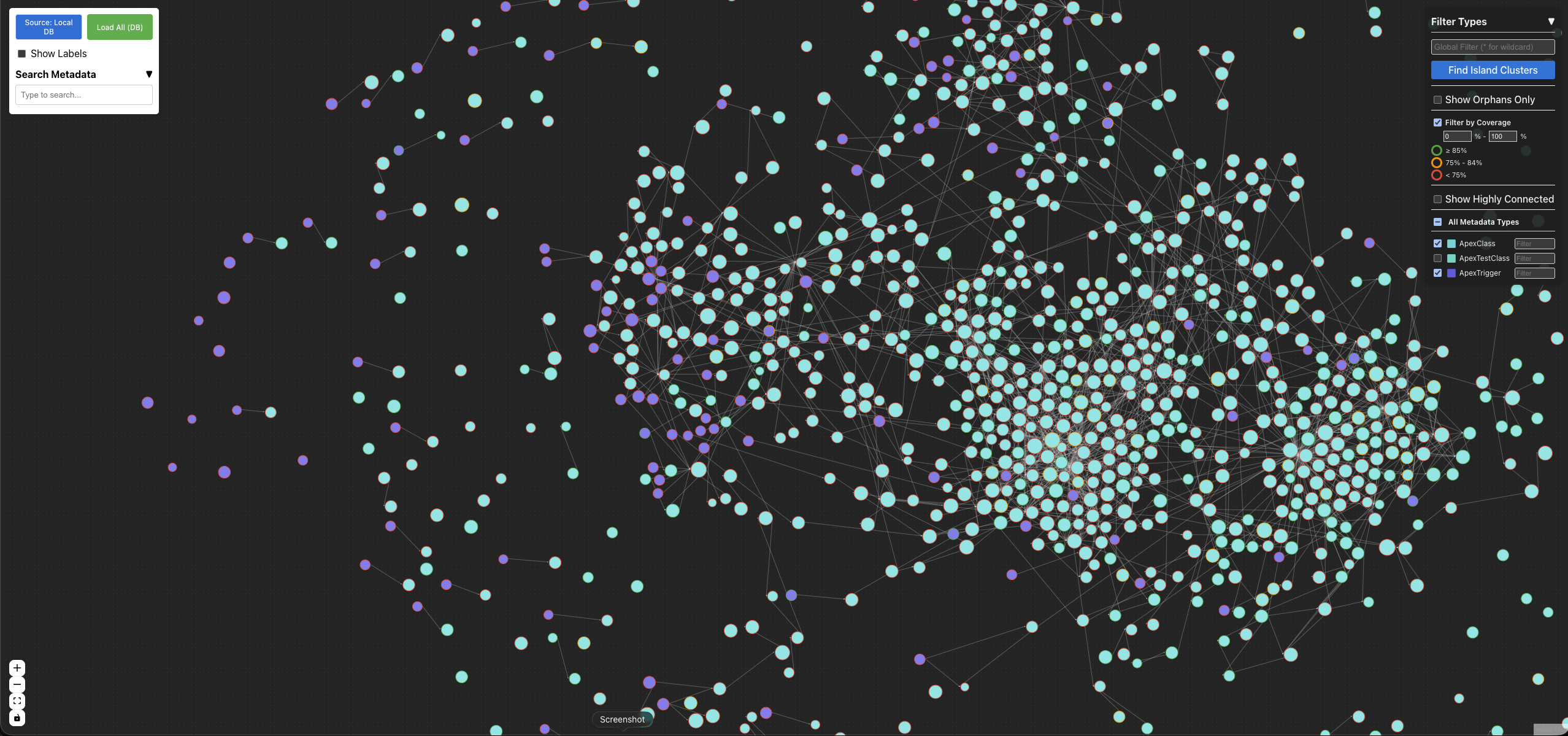
- Visualize: It renders an interactive node graph in a React-based web interface
Note! It is also possible to source the dependencies on demand on from Salesforce without extracting them into the local database
Interactive Visualization
- Group and Drag: Organize nodes to match your mental model of the architecture.
- Filter: Search for specific metadata to isolate subsystems.
- Trace Paths: Clearly see how a change in a utility class cascades up to a Trigger or Page
- Show orphans only: Identify quickly metadata that does not have any dependencies. These are possible candidates for deletion
- Show highly connected nodes: Identify quickly metadata that have high amount of dependencies.
- Find Island clusters: Identify group of dependent metadata that could possibly be isolated to packages
- Find large metadata: The size of the nodes corresponds to the size of the metadata, especially useful when identifying “God Classes” that are doing too much
- Find Apex classes and trigger with low coverage: Apex test coverage is visualized on Apex classes to be able to easily identify which classes have low (or no coverage)
Dependency visualization helps with:
🛠 Safe refactoring
🔄 Technical debt cleanup
🚀 Release planning
🔍 Impact analysis before deployments
📉 Reducing production incidents
Note! Salesforce Metadata Dependency does not include all metadata dependencies
Have a look: https://github.com/ruohomaa/dependency_viewer
 Yet Another Salesforce Tech Blog
Leave a comment